

Your products are on the shelf. Are they really?
Smart MERCHANDISING is the shelf audit application in the Smart SALES suite. The merchandiser walks into the store, records prices item by item, photographs the shelf and flags stock-outs. You know what is there, and in what state. Smart MERCHANDISING is retail audit and store audit software.








The shelf is the last metre of your marketing
Right product, right price, right time, right place, right quantities: five conditions. One missing is enough.
An unreported stock-out is a sale that never took place and a customer who reaches for the brand next to it. A price that has drifted, a competitor's promotion up for three days, an empty end-of-aisle display: none of that shows up on a sales report.
Smart MERCHANDISING puts a structured audit behind every visit to a store. What the merchandiser sees in front of the shelf leaves with its location and its photos, during the visit.
In front of the shelf, everything is entered once
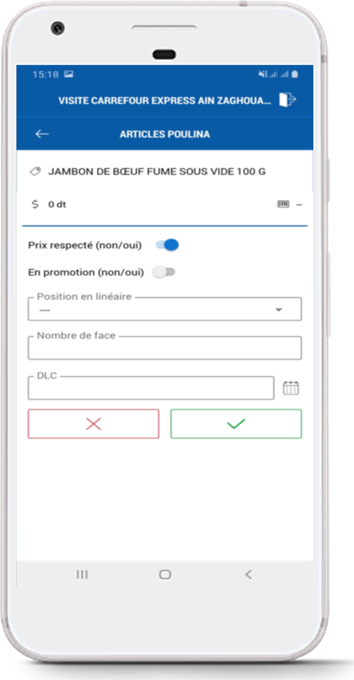
Price, promotion, position, number of facings, use-by date: item by item, on the spot.
The item, then the shelf
The merchandiser opens the list of product lines tracked in that store and works through them one by one, with the product in front of them.
Six fields per item
- The price recorded on the shelf
- Price respected, or not
- Item on promotion, or not
- The position on the shelf
- The number of facings
- The use-by date
The list of product lines is specific to each store: it is the typology of merchandising items for that sales point.
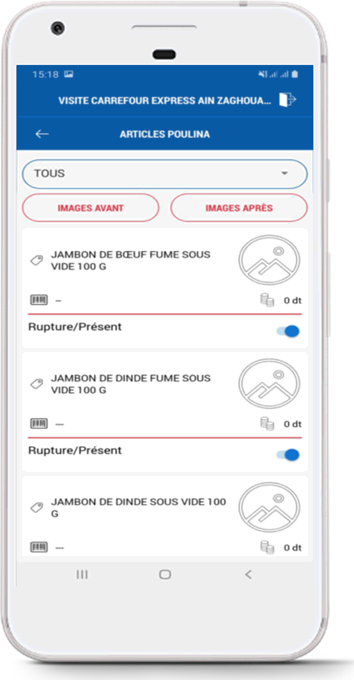
Stock-out and low stock
The two are not handled the same way. The stock-out is already there; low stock still leaves time to restock. The audit tells the two apart.
Before, after
Two sets of photos per visit. You see what the merchandiser found, and what they left behind.
What the report takes away
- The items recorded and their price
- Stock-outs and low stock
- The photos taken before and after the visit
- The promotional campaigns found in the store
- A free description, written on the spot
The cancelled visit counts too
A visit that did not take place stays on the board, with its reason. The cancellation reasons are entirely configurable: you are the one who writes the list.
What the competitor does is recorded too
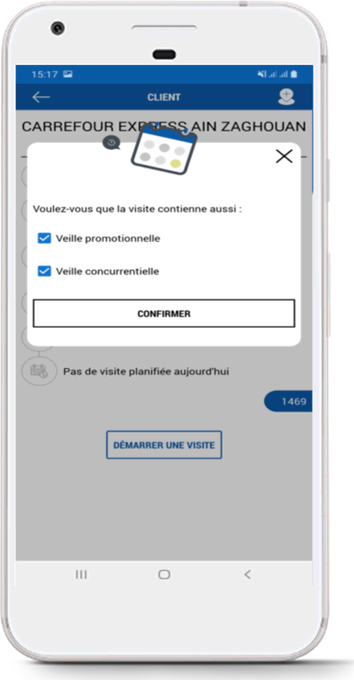
Two watches, as you choose, attached to the same visit: the promotional one and the competitive one.
At the start of a visit, the merchandiser states whether it also carries a promotional watch, a competitive watch, or both. The shelf audit and the market audit fit into the same visit, and leave in the same report.
The promotional watch
It records every promotional campaign found in the stores visited. The schedules are set in advance, at a frequency you set. Watches that are planned, carried out and cancelled are listed separately.
The competitive watch
- The company — the competitor's name, on every campaign recorded
- The items — those on promotion, with the start date and the end date
- The mechanism — the form the promotion takes
- The in-store display — the position obtained and the promotional activity in place
- The photos — taken on site, attached to the audit
From these audits comes an analysis of your positioning on the market against the competition, store by store.
Every retail chain has its record, every merchandiser has their territory
Who visits what, how often, on which days and at what times: set once, applied everywhere.
Large-scale retail outlets and sales points are maintained from the back office. They are shared out by geographical division and by merchandiser: each one gets their territory, and two merchandisers never cross paths in the same store.
Customer categories and classifications are entirely configurable. You name your own families of retail chains, and the application applies them — with no bespoke development.
What a store record carries
- The contact details of the sales point and its location
- The merchandiser and the area manager assigned to it
- The frequency of visits, the days and the times
- The typology of merchandising items: the product lines tracked in that store
The agreements
The agreements reached with large-scale retail outlets are managed in the application, in the same place as the stores and the visits.
Point-of-sale campaigns
Point-of-sale advertising operations are scheduled: which campaign, in which store, on which date. The merchandiser's visit is then used to check that it was carried out as agreed.
A team out on the road is run on numbers
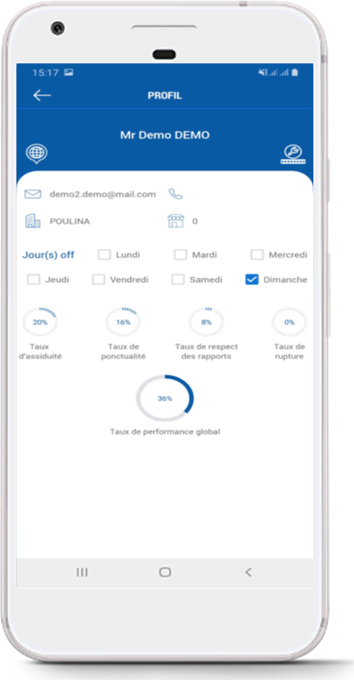
Five rates, kept for every one of them, readable in the application as much as at head office.
The merchandiser finds their own record in the application: their contact details, their days off, and the rates that measure their work. They do not discover their figures at the annual appraisal — they have them in front of them between two stores.
The five rates tracked
- Attendance rate
- Punctuality rate
- Rate of compliance with reports
- Stock-out rate
- Overall performance rate — across all their customers
Head office, for its part, tracks merchandiser activity in real time. The supervision reports arrive with their location and their photos, and not three days later as a summary.
The administrative management of the team goes through the same tool: scheduling visits, days off, allocating territories.
Six modules, and the organisation stays yours
Multi-subsidiary, multi-catalogue. The categories, the reasons and the frequencies are yours to write.
Reporting is configurable to suit your analysis and decision-making needs: what you want to read, you declare. From that come a qualitative and quantitative analysis of your sales points, and a study of targets that sheds light on consumer behaviour.
The sales point 3
-
Retail outletsLarge-scale retail outlets and sales points, with their locations
-
AgreementsThe agreements reached with retail chains
-
SchedulingVisits prepared in advance, merchandiser by merchandiser
The shelf and the market 3
-
SurveysThe visit reports: the shelf audit, photos, stock-outs
-
CompetitorsCompeting companies and their items
-
CampaignsPoint-of-sale advertising operations, planned and then checked
The same metre of shelf has to satisfy three people at once
The consumer, the supplier, the distributor. None of the three looks at the shelf for the same reason.
The consumer
They come in to find an answer to what they are after: an assortment that speaks to them, products genuinely available — so no stock-outs — and a shelf that is clear, attractive and informative enough for them to choose without hesitating.
The supplier
They want to present their offer and move their products: to take up shelf space in line with their market share, and to see their image and the distinctiveness of their range respected, store after store.
The distributor
They want to be recognised and paid for their service as an intermediary: presenting the offer attractively for the customers they have as much as for those they are aiming at, taking account of what makes them distinctive.
- 1single visit to the store serves the shelf audit, the promotional watch and the competitive watch
- 0rekeying on return: the report leaves the store, photos and location included
- 100%configurable: store categories, cancellation reasons, the frequency of the watches
A smartphone in your hand, the shelf in front of you
The application fits in the merchandiser's pocket and keeps going when the network does not.
Smart MERCHANDISING works online and offline alike. The audit, the photos and the visit report all happen with no network; everything goes up at the next synchronisation.
The interface is touch-based and adapts to the different screen sizes of smartphones. The merchandiser works standing up, one hand on the device, the other on the product: the interface is designed for that, not carried over from a desktop.
The application is connected to the Smart SALES back office: master data for stores and items, categories, frequencies, consolidation of the audits. It is through the back office that exchanges run with your management system, which stays in place.
Reports and statistics are read in real time, and their format is set according to what you need to analyse in order to decide.
What people ask us before the first store
Smart CRM supports the sales rep who sells: they present, negotiate, take an order. Smart MERCHANDISING supports the merchandiser who checks the shelf: they record a presence, a price, a position on the shelf and the state of the shelf. Two trades, two applications, one single back office.
Item by item: the price recorded, whether or not the price is being respected, whether a promotion is running, the position on the shelf, the number of facings and the use-by date. To these are added the stock-out or low stock, a free description and the photos taken before and after the visit.
Yes. The audit, the photos and the visit report all happen offline, which matters in a store where the network is poor. The data goes up to the back office as soon as the connection comes back.
By dividing up the geographical area and by merchandiser. Every store carries the merchandiser and the area manager assigned to it, the frequency of its visits, and the days and times at which they take place.
Yes. Store categories and classifications, reasons for cancelling a visit, the frequency of promotional watches, the format of the reports: all of it is configurable. The organisation can be multi-subsidiary and multi-catalogue.
A store visit replayed with your own product lines
One store, ten items, a price audit, a stock-out, two photos. Forty-five minutes, no commitment.
- A demonstration on your own retail chains, your own product lines and your competitors
- A technical contact, not a salesperson
- A reply within one working day
- Your data is used only to reply to you