

The goods are in the truck, the invoice leaves with them
Smart SELLER is the door-to-door sales application in the Smart SALES suite. The seller loads the truck in the morning, drives the round, sells, prints the invoice or the delivery note, and collects payment. The truck stock and the cash position follow, sale after sale. Smart SELLER is van sales software: route accounting and direct store delivery from the truck.








The truck comes back at night, and the day starts at the office
Delivery notes to copy out, cash to count again, unsold goods to find: the round is over and everything is still to be keyed in.
The mobile seller sells standing up, fast, often with no network. They have no office and no second visit: whatever is not recorded at the moment of the sale is pieced together in the evening, from memory, out of a notebook.
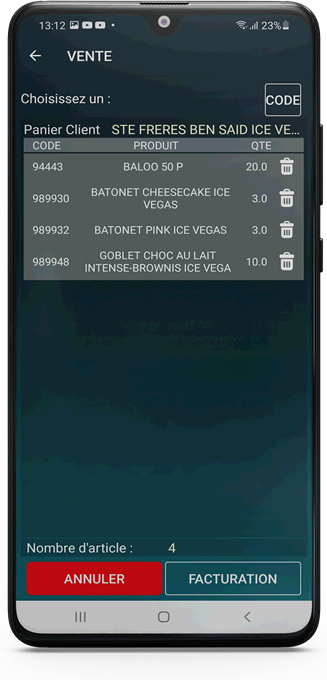
Smart SELLER moves data entry to where the sale happens. The document, the payment, the stock left and the goods returned are all recorded in front of the customer. The depot reads the day as it unfolds.
The day is written before the truck sets off
The round planned, the customers in the area listed, the forgotten ones flagged. The seller knows where they are going and what they are taking.
The customer card, complete and up to date
Rounds are planned in advance from the back office. The seller finds theirs at start-up: the customers in their area, in order, and each one's card opened with a single tap.
- Nature of the account — private individual, company or public body
- Commercial status — prospect, customer, according to your own nomenclature
- Price — the price reserved for this account, set in the back office
A customer met along the way is created on the spot and enters the database with its geolocation. The customer database builds up round after round, geolocated.
The customers we skipped
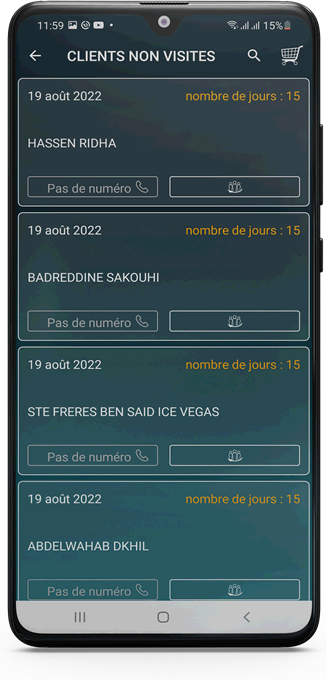
The list of unvisited customers can be produced for any period you choose. The length is set in the back office, according to your coverage policy.
Potential shows on the map
Sales are tracked geographically. You see where the turnover is made, and where possible customers have never been approached.
What the seller has in front of them
- Their round for the day and the customers in their area
- The customer card, updated in real time
- The catalogue and the prices that apply to this account
- What is left in the truck
- Their cash position
- The customer's current invoices
Salaried or commission-based
Smart SELLER drives salaried sellers just as it drives licensed commission agents. Each has their own account, area, stock and cash; the status changes the pay, not the tracking.
The invoice prints before the truck drives off
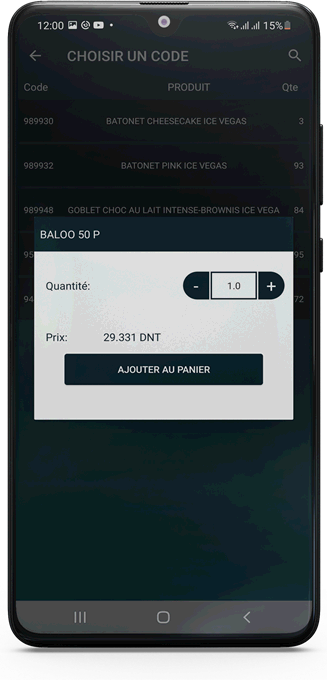
Two sales modules coexist: by invoice, and by delivery note. In both cases, the document is generated and printed immediately after the sale. The customer leaves with their document, and the depot has nothing to key in again.
Payment is collected in the same movement. The payment methods you accept are defined in the back office, and the seller's cash position is kept throughout the round. The customer's current invoices can be viewed on their card: what they already owe is visible before selling them anything else.
Sell what you have, order what is missing
The tree of item categories is fully configurable — family, category, sub-category, as many levels as your range requires — with special categories defined from the back office. The catalogue is carried in the application and updated in real time.
Whatever the truck is not carrying can be ordered on the spot. The order enters a multi-level approval workflow whose criteria are your own, and its amount is calculated from the customer type and the seller type. The history and the processing status remain available from the field.
The truck is a depot on wheels
Every sale comes out of the truck stock. The inventory says what is missing, and the return says why.
The truck stock is kept in real time: what was loaded, what was sold, what is left. The seller no longer has to guess whether they can serve the next customer, and the depot does not wait for unloading to know what to prepare for the next day.
The inventory is done from the application and brings out the discrepancies between theoretical stock and counted stock. A discrepancy is dealt with the same day, at a precise point on the round, and not three weeks later on a summary table.
Intact return
The goods go back into the sale stock and set off on the round the next day. They have never left the sales circuit.
Defective return
They are set aside to be replaced. They leave the saleable stock and enter a queue of their own.
Separating the two sides means telling apart what comes back because it was not sold from what comes back because it was not saleable. Control of the work done in the field starts exactly there.
Twelve modules, everything a round asks for
None is compulsory. You start with sales and truck stock; the rest is added when it earns its place.
Two things are configurable end to end: the tree of item categories and the order approval workflow. The rest follows your organisation — multi-subsidiary, multi-invoicing, multi-item catalogues.
The truck 2
-
StockThe state of the truck in real time, inventory included
-
Goods returnsIntact or defective, never mixed
The sale 4
-
Invoices and delivery notesGenerated and printed at the moment of sale
-
Cash statementThe customer's payment, method by method
-
Product catalogueConfigurable tree, prices per customer
-
OrdersMulti-level approval, history retained
The customer 3
-
Customer cardThe whole account, updated in real time
-
PlanningRounds prepared in advance
-
Inactive customersThe unvisited, over the period you set
What comes back 3
-
AssetsThe equipment entrusted to sales points
-
ComplaintsWhatever goes wrong, reported during the visit
-
SuggestionsThe ideas picked up in the market
The refrigerator lent to the customer remains your asset
A refrigerator, a television set: equipment installed at the customer's is tracked like everything else.
Many companies place equipment with their sales points. Once installed, it drops off the radar: nobody knows any more how many units are where, nor in what condition, nor whether they serve the purpose they were lent for.
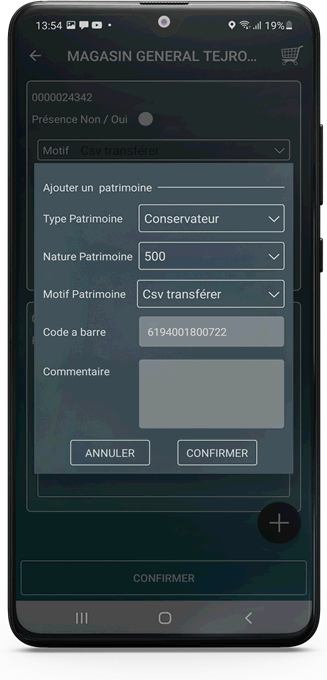
Smart SELLER makes this a module in its own right. Equipment on loan becomes a tracked asset again, with its history, and it is the round that keeps it up to date — not an annual inventory.
What the module tracks
- Allocation — requests come from the field, where the need is visible
- Presence and use — checked during the visit, unit by unit
- Discrepancies — any anomaly in the number of items of equipment installed at the sales point is reported
- Maintenance — requests and completed servicing stay attached to the equipment
The seller, the supplier, and the shopkeeper at the end of the street
The same round serves three interests that are nothing like each other.
The mobile seller
They follow their sales as the day goes on, find their customers and each one's history, and close faster: the transaction takes a few taps, document and payment included. A well-served customer sees them again the following week.
The supplier
They drive salaried sellers and licensed commission agents alike, control the work done in the field, and build a complete, geolocated customer database that belongs to them. Productivity gains and a quick return on investment are the two benefits SYMATIQUE has put forward since the very first version.
The sales point
It is served by someone who knows its account, finds the goods in the truck — the stock on board is known before the round sets off — and gets its invoice printed there and then. Three reasons to buy now rather than wait for the next visit.
- 1geolocated customer database, built round after round, which stays yours
- 2seller statuses driven side by side: salaried, licensed commission agent
- 0rekeying at the depot: the document is issued in front of the customer
A smartphone in one hand, the goods in the other
The application runs online and offline alike, on the devices the seller already has in their pocket.
Smart SELLER works online and offline alike. The sale, the printing of the document and the collection of payment carry on when the network is missing; everything goes up at the next synchronisation.
The interface is touch-based, designed for PDAs and smartphones — not for a desktop workstation transposed onto a small screen. The operating platform is Android.
The organisation follows yours: multi-subsidiary, multi-invoicing, multi-item catalogues. Salaried sellers and licensed commission agents live side by side in the same system.
Complaints and suggestions come back through the same application: whatever goes wrong at a customer is reported during the visit, and an idea picked up in the market does not stay in a notebook.
The application is connected to the Smart SALES back office — master data, prices, approval workflows, real-time consolidation of data — and it is through it that the exchanges with your management system pass, and that system stays in place.
What people ask us before the first truck is loaded
Smart CRM supports the sales rep on a visit: they present, negotiate and take an order that will be delivered later. Smart SELLER supports the seller who has the goods with them: they sell, deliver, invoice and collect payment in the same visit.
Yes. Sale, invoice, delivery note and payment collection all happen offline. The data goes up to the back office at the next synchronisation.
On PDAs and Android smartphones. The touch interface is designed for use standing up, in the truck or on the doorstep.
Yes. Two modules coexist: sale by invoice and sale by delivery note. Both print immediately after the sale.
Like salaried sellers, in the same system: each has their own account, their truck stock, their cash position and their rounds. The status changes the pay, not the tracking.
A day of selling replayed with your own items
Loading the truck, two customers, one invoice, one payment, one goods return. Forty-five minutes, no commitment.
- A demonstration using your own items, your prices and your payment methods
- A technical contact, not a salesperson
- A reply within one working day
- Your data is used only to reply to you